Every Robot Track Record Moved at Once
In short
- At the 2026 World Humanoid Robot Games, robots beat the human record in four of six timed track events. In 2025 they lost all of them.
- Two of the three 100m “records” the English press ran were heats; the final was 8.64 seconds. The organizers said in Chinese that robot and human records aren’t comparable.
- The robots’ edge grows with distance, from 10% at 100m to 31% at 1500m. The high jump compared a pre-ceremony demonstration with Sotomayor, under a rule that scores something else.
- The ratified 100m record for a bipedal robot is still 24.73 seconds, from 2022. Four events jumping 2.3× to 3.2× in one year, across different teams, is still unexplained.
A humanoid robot ran 100 meters in 9.39 seconds at the World Humanoid Robot Games in Beijing on August 22, and every English-language outlet I could find printed that number next to Usain Bolt’s 9.58. CBS, Bloomberg, Fortune, NBC, ESPN, Al Jazeera, France 24, ABC.
Three days later another team from the same lab ran 8.86, and the wires went again. On the closing night the final ran, and a third team won it in 8.64.
Neither of the first two numbers was a final. The 9.39 came out of a preliminary heat and the 8.86 out of a semifinal, so for four days the record every English headline was built on was a qualifying time. The organizers had already said the comparison doesn’t hold. They said it in Chinese, and it didn’t cross.
I went looking for the Chinese coverage because a machine getting 2.5x faster in twelve months is either a real breakthrough or a change in what’s being measured, and the English reporting gave me no way to tell which. What I found is that the 100m wasn’t the story. Every timed event moved at once.
The entire slate jumped by the same factor
| event | 2025 | 2026 | human record | one year |
|---|---|---|---|---|
| 100m | 21.50s | 8.64s | 9.58s | 2.49x faster |
| 400m | 1:28.03 | 38.15s | 43.03s | 2.31x faster |
| 1500m | 6:34.40 | 2:21.64 | 3:26.00 | 2.78x faster |
| half marathon | 2:40:42 | 50:26 | 56:42 | 3.19x faster |
Every machine in the 2025 column is slower than a person, most by a factor of two. Across the full slate, which includes two events not in this table, the 2026 robots beat the human mark in four of six.
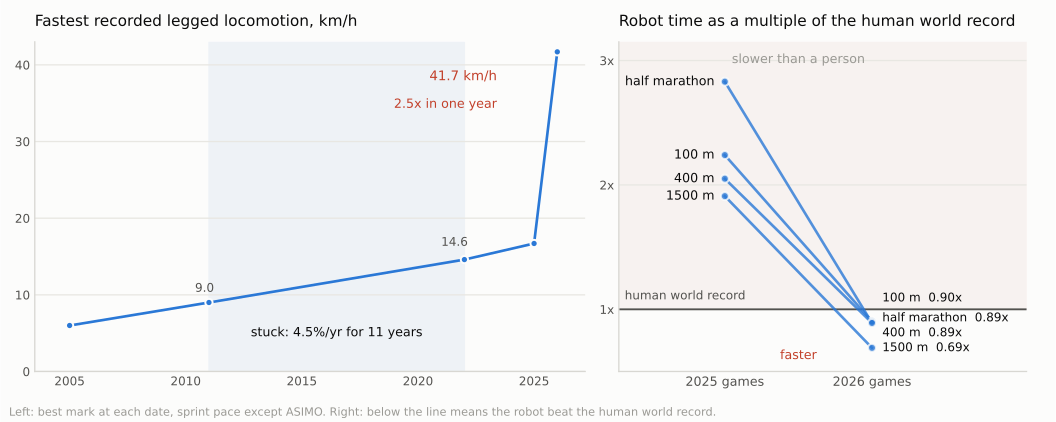 Left: eleven years at 4.5% a year, then a step. Right: robot time divided by the human world record. Above the line is slower than a person, below it is faster. All four events cross in twelve months.
A single event improving 2.5x could be one team’s breakthrough. Four events improving 2.3x to 3.2x at once, across different teams and different machines, is a claim about the field.
Legged robots were stuck for a decade
Some of this is real, and the record makes that clear.
| year | machine | speed |
|---|---|---|
| 1996 | Honda P2 | walking only |
| 2005 | ASIMO | 6.0 km/h |
| 2011 | ASIMO | 9.0 km/h |
| 2022 | Cassie | 14.6 km/h |
| 2025 | Tiangong Ultra | 16.7 km/h |
| 2026 | Tiangong Ultra | 41.7 km/h |
ASIMO’s 9 km/h stood for roughly eleven years. From 2011 to 2022 the field compounded at 4.5% a year, which is another way of saying it was stuck. Then reinforcement-learned gaits arrived, and from 2022 to 2026 it compounded at 30% a year.
The inflection is genuine, and the Chinese engineering account of it contains one item more impressive than the sprint time: track-line following replaced by SLAM, so the machine navigates instead of following a stripe. That got no English coverage at all.
The 2026 number still doesn’t fit. A 2.5x year is an outlier against a curve that is already bending sharply upward. That’s the reason to want the rulebook before believing the headline.
What the organizers actually published
Robot competitions and human track events are not equivalent in starting method, body structure, or timing certification. The meet’s results and human world records belong to two different systems.
需要说明的是,机器人比赛与人类田径赛事在起跑方式、身体结构、计时认证上并不等同,赛会成绩与人类世界纪录属于两个体系。
That is the event’s own statement, carried in Chinese coverage and absent from every English report I read.
Three more things are in the Chinese daily coverage.
Two of the three record runs were qualifying. The 9.39 came out of the large-class preliminary round on the evening of August 22: nine heats, forty teams. The 8.86 came out of the first semifinal group on the 25th. Team Tianjiao won the final on the 26th in 8.64 and took second as well, so the fastest 100 meters a robot has ever run got a single news cycle, on the day the games ended.
The wires split on it. Reuters placed the 8.86 “in the semifinal of the large-size robot division”; the AP version that ran in ABC News and the Washington Times gives the time, Bolt’s 9.58, and the three-day-old 9.39, and never names the round. By the closing day both had it, and the Global Times called it the “100-meter large-group final.” The correct round arrived once the story was over.
The AP’s closing piece carries the detail no record table will: several finishers, the champion among them, hit the padded barrier past the line, and staff came out with extinguishers for the machines throwing sparks on the ground. Stopping is not in the timed result.
The classes are new. 2026 split the track events by height for the first time. Large class is over 1.4 meters, small class under. Last year ran one undivided field, which is how an 80cm entry from Beijing Union University ended up racing the same 100m as a 1.8m Tiangong Ultra.
Four teams collapse into one English name.
| Chinese | English | What they won |
|---|---|---|
| 天工 | Tiangong (also Tien Kung, “Sky Project”) | 400m both classes, 4x100 relay |
| 天卓 | Tianzhuo | 1500m, standing high jump; first across in the 100m heat |
| 天骄 | Tianjiao | the 100m final, long jump, 400m obstacle |
| 天骁 | Tianxiao | 100m small class |
Three of those four are teams of the Beijing Humanoid Robot Innovation Center, and the machine under all of them is a Tiangong Ultra. So the English framing, one model improving from 9.39 to 8.86 to 8.64, is right about the hardware and loses the three different teams. The stray 9.32 figure is credited variously to Honor’s “Lightning” in a pre-event test and to Tiangong Ultra in a later heat, and I could not reconcile those from public sources.
Robots win the events humans lose to fatigue
Once you have the class splits and the full slate, “robots beat humans” is six claims, not one:
| event | robot | human record | margin |
|---|---|---|---|
| 100m | 8.64s | 9.58s | +9.8% |
| 400m, large class | 38.15s | 43.03s | +11.3% |
| 400m, small class | 45.66s | 43.03s | −6.1% |
| 1500m | 2:21.64 | 3:26.00 | +31.2% |
| half marathon | 50:26 | 56:42 | +11.1% |
| long jump | 7.97m | 8.95m | −10.9% |
The advantage grows with distance: ten percent at 100 meters, eleven at 400, thirty-one at 1500. Batteries don’t produce lactate, so the longer the race runs, the more the human record measures human physiology and the less it says about the machine. Human sprinters hold about 89% of their 100m pace over 400 meters; the large-class robots held 91%.
Where the event needs one explosive effort instead of sustained output, the robots lose. The long jump went 7.97 meters against Mike Powell’s 8.95 from 1991, and a small-class robot over 400 meters is slower than a person. The half marathon breaks the trend at 11.1%, which I’d put down to road conditions and battery rather than gait.
The high jump is measuring something else entirely
A robot cleared 2.8843 meters in the standing high jump, against 95.641 centimeters last year by Robot Era’s Xingdong L7. Coverage put the 2026 figure next to Javier Sotomayor’s 2.45.
The 2.8843 was a demonstration held before the opening ceremony. The medal event ran on August 25 and was won at 3.4 meters by Team Tianzhuo’s entry 015, with Tiangong Ultra machines taking all four top places. Xinhua’s own closing summary frames the year as 0.95641 meters to 3.40, final against final. English coverage ran the exhibition figure against Sotomayor and never carried the medal result, which means every Sotomayor comparison in the English press was drawn against a demonstration.
Here is the scoring rule:
The score is the vertical distance from the ground to the lowest point of any part of the robot’s body at the apex of the jump.
以机器人跳至最高点时,身体任何部位最低点至地面的垂直距离为成绩。
The rules (source, in Chinese) deliberately don’t prescribe how the robot jumps. So the number is total body clearance in a standing jump with no constraint on method, and Sotomayor’s 2.45 is bar clearance in a running jump. Those are different quantities measured differently, not two versions of one event.
This one isn’t a translation failure either. Chinese coverage describes 2.45m as the human men’s two-footed standing high jump best, when Sotomayor’s record is a running jump. The error starts in the Chinese wire and English coverage inherited it whole.
The games price teleoperation at half value
Twenty-one of the 51 events in 2026 were scenario events, up from six in 2025. That is where the expansion went, not into track.
Scenario scoring applies a weight of 1.0 to a task completed fully autonomously and 0.5 to the same task under remote control. Several competitive events, the 400m among them, dropped teleoperation entirely this year and run fully autonomous end to end.
Teleoperation is the credibility question in humanoid robotics. Whether the robot in a demo is thinking or being driven is what every skeptic asks first, and companies get accused of blurring it constantly. The organizers of these games wrote an answer into the scoring. A driven robot earns half.
I found no English coverage of that at all.
Here is what the scenario slate produced on August 23:
| scenario | champion |
|---|---|
| library, book organisation | Tsinghua / Shanghai Jiao Tong / Zhiyuan joint team, 270 points |
| hotel, guest service | Youliqi Black Panther |
| emergency, fire rescue | Shanghai Zhiyuan |
| garden, park management | Beijing Humanoid with Henan University of Science and Technology |
| home, housekeeping | Beijing Galaxy Star Digital |
The tasks are specific in a way a sprint is not. Picking beans up with tweezers. Turning screws. Weighing powder. Closing valves. The garden robots had thirty minutes to check for prohibited items, remind visitors about uncivil behaviour, and pick up litter. Xinhua frames the category as aimed at labour gaps in dirty, dangerous, tedious and difficult work. Whether that pans out is a separate question; it is at least a claim about deployment rather than about speed.
The rest of the program went the same way. Tsinghua’s Vulcan team won the 2025 5v5 football final 1-0 against a German joint team, HTWK Robots and Nao Devils, the only non-Chinese finalist I found in either edition. The University of Hong Kong’s SMASH team took the table tennis. AgiBot’s Lingxi X2 won the 100m obstacle in 1:28.32, and AgiBot topped both medal tables on its first appearance, 18 golds and 46 in total, using production models rather than purpose-built racers; its dexterous-hand subsidiary took seven of the eight hand events. The organizers closed by announcing the free release of 2,500 hours of real-world humanoid data across twelve scenarios and forty-four tasks. That last item has a better claim on the next year of this field than any time on the track, and none of it produced a headline in English.
What is actually on the books
I put together every robot athletic record I could source and check, forty-one of them, with the caveats attached. The ones that matter:
| event | mark | machine | date | status |
|---|---|---|---|---|
| 100m | 24.73s | Cassie (Oregon State / Agility) | 2022-05-11 | Guinness-ratified |
| 100m | 9.39s | Team Tianzhuo | 2026-08-22 | press reports, heat |
| 100m | 8.86s | Tiangong | 2026-08-25 | press reports, semifinal |
| 100m | 8.64s | Tianjiao | 2026-08-26 | event-official, final |
| humanoid walking | 3.3 m/s | Unitree H1 V3.0 | 2024-03 | Guinness-ratified |
| legged top speed | 45.5 km/h | BD Cheetah | 2012-03 | treadmill, tethered, quadruped |
| free throws | 2,020 consecutive | Toyota CUE3 | 2019 | Guinness-ratified |
| farthest shot | 24.55m | Toyota CUE6 | 2024-09-26 | Guinness-ratified |
The ratified 100 meter record for a bipedal robot is still Cassie’s 24.73 seconds, set at Oregon State in May 2022. Guinness has ratified nothing from either edition of the Games. The official number and the headline number are 16 seconds apart and no one reconciles them.
Boston Dynamics’ Cheetah is in there because it’s the actual ceiling. 45.5 km/h in 2012, still unmatched fourteen years later, and it was a quadruped on a treadmill tethered to off-board hydraulics. Coverage that compares robots to sprinters never mentions it.
One more thing. Every Guinness-ratified record here is American or Japanese and at least two years old. Every Chinese mark is event-official or press-reported. That is not a claim about who builds faster robots. It’s a claim about who submits to outside ratification, and it explains why the fastest reported time and the fastest verified time are two different marks.
What the rules explain, and what they don’t
The rulebook accounts for a lot of the confusion: two of the three record runs were qualifying, the height classes split a field that used to run together, the high jump scores a different quantity than the human event it got compared to, and the organizers disclaimed the comparison outright.
The engineering account is specific, and it exists in exactly one place I could find: a Beijing News explainer, in Chinese. Joint torque ceilings raised to roughly small-EV levels. Bigger batteries to sustain the draw. Lighter frames. Per-event tuning, which one engineer sums up as the 100m wanting acceleration while the 400 and the 1500 want cornering. And about a month of concentrated reinforcement-learning training per event. All of that is plausible and most of it is checkable.
None of it explains the size of the jump. A field compounding at 30% a year can produce a big season. But nothing I found accounts for four events moving 2.3x to 3.2x at the same time, across different teams, on different machines. Synchrony like that usually means a rule changed or a measurement changed. I could not find evidence of either.
What would settle it: a published timing methodology, a diff of the 2025 and 2026 rulebooks, and ratification by somebody who doesn’t run the event. None of the three exists publicly.
The event said it first
The robots are fast and getting faster quickly, and the engineering account holds up. I’m not arguing the results are fake. The comparison is the broken part. The disclaimer about starting methods and timing certification was in the Chinese copy and never made it into English.
The half of the event that was trying to be rigorous got left behind. An organizing committee that halves your score for driving the robot is taking the hard question seriously, more seriously than most of the companies whose demo videos get reposted without comment. That was the story, and it was in the scoring rules.
Assembling any of this is harder than it should be. There is no official results feed in any language, and the most complete medal table I found for the 2025 games is a PNG image on a Beijing municipal government website. Which results survive is close to arbitrary. The 2026 relay time was published; the combined five events was not, and that is the closing-day event where robots run 100 meters while handling tools and carrying loads. It answers the objection a bare sprint invites better than anything else on the programme, and it has no published result in any language.
If you want the number that survives every asterisk: a bipedal robot has been officially timed at 24.73 seconds over 100 meters, and that record is four years old.
Primary sources. Almost none of this is available in English, so the Chinese originals are the useful links:
- ZAKER - the 2026 sprint, with the year-over-year comparison the English wire didn’t run
- 163.com - carries the organizers’ non-comparability statement
- Sina - the standing high jump scoring rule
- Xinhua and Guangming - 2026 daily results, including the height classes
- Xinhua photo wire - the 100m final, both classes, with the team names
- Xinhua closing summary - year-over-year on every track record, final against final
- Xinhua, 2025 and Beijing News - the first games
- Beijing municipal science commission - the fullest 2025 medal table anywhere, published as an image
For the older records: Guinness, Oregon State on Cassie’s 5K, IEEE Spectrum on Honda’s P2, and the 2015 DARPA Robotics Challenge finals.