What freedom is for
In short
- AI is sold as freedom: the machines do the work and people get their time back. Capability arrives first, and it fills the time.
- Freedom has two parts, the power to say no and the calm of not needing to. Money and machines supply the first. Wanting grows with means, so the second keeps moving away.
- What freedom is for has an old, plain answer. AI brings the question early and leaves the answer to us.
Keynes made the forecast in 1930. Within a century, he wrote, the economic problem would be solved or close to it, and people would face what he called the “permanent problem”: what to do with the freedom.
The people building AI make the same forecast now, on a shorter clock. The machines do the work, and people get their time back.
The pitch is freedom. What ships is capability. I build with AI agents every day and I’m an optimist about them, and this is the part of the pitch I’d want the labs to say out loud.
Capability fills the time
What the agents give me is capability. An idea can go as far as it goes: researched, built, tested and shipped.
That turned out to be a reason to work more. A tool that makes each hour worth more makes each hour off cost more. Keynes saw this coming too: “For we have been trained too long to strive and not to enjoy.”
Machines supply the power to say no
Ask people what free means and most answers have two parts. One is the power to say no to anything. The other is the calm of not needing to: no fear, no worry.
Money and machines supply the first. The second keeps moving, because wanting grows with means. Epicurus wrote it down around 300 BC: “Nature’s wealth at once has its bounds and is easy to procure; but the wealth of vain fancies recedes to an infinite distance.”
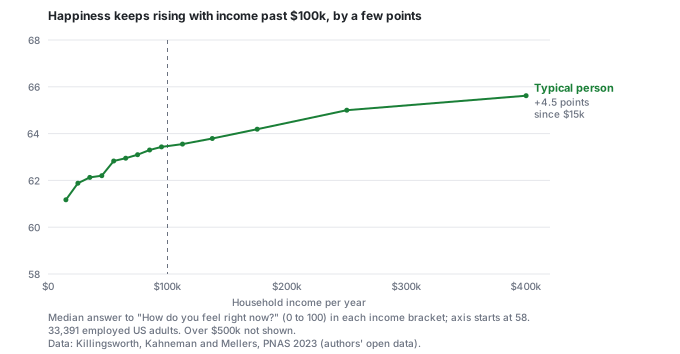
The data agrees, gently. In a 2023 study, Killingsworth, Kahneman and Mellers found well-being rising with income well past $100,000 a year for most people, by small amounts. The climb pays a little and doesn’t end. Every goal gets an “and then more.”
The Stoic, Buddhist, Hindu and Christian traditions all put freedom on the second side: steadiness in gain and loss. Nobody has found a way to sell it.
Freedom is for something
Keynes looked at the people who already had the freedom, the rich of his day. Most of them, he judged, had “failed disastrously”: “those who have an independent income but no associations or duties or ties.” The power to say no answers what you’re free from. It says nothing about what for.
That answer is old and plain. Ecclesiastes says every man should “eat and drink, and enjoy the good of all his labour, it is the gift of God.” Epicurus ranked friends above everything else wisdom can get you.
The hard part is getting to it past the climb.
Keynes’s century is almost up
He gave it a hundred years, which runs out in 2030. For most people the economic problem isn’t solved: someone who can’t cover rent can’t say no to anything, and telling them to want less is advice from comfort.
Keynes was right about the problem and wrong about who would reach it first. His advance guard was the rich. Ours is the people with the best tools: each month the tools do more, and the question of what it’s all for stays where Keynes left it. Living the answer is the part the machines don’t do.