Six Men's Morris Is a Draw: The First Published Solution
Morris is the family of mill games. You place men on a board of lines, then slide them along it; three of your men on a marked line forms a mill and lets you remove an opponent’s man. Run an opponent below three men and you win.
Nine men’s morris is the famous one, solved for over thirty years: Ralph Gasser strongly solved it in 1993, a draw with perfect play, and Gévay and Danner computed extended solutions across the family in 2014.
Six men’s morris, the same board with its outer ring removed, is on every list of morris variants but not in the solving papers. I strongly solved it: a draw, over all 42,372,745 reachable positions.
Open the perfect-play explorer → Play any line against the tablebase: every move is coloured by its result under perfect play, green for a win, grey for a draw, red for a loss. The size toggle switches between four, five, and six men a side.
The game
Six men’s morris is played on two concentric squares joined by lines at the four side-midpoints: 16 points, no diagonals. It is the nine men’s morris board with its outer square taken off.
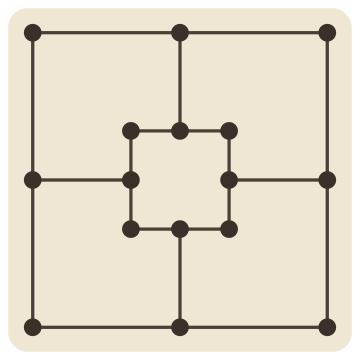
Each player has six men. First comes a placement phase, putting men on empty points in turn; once all twelve are down, the movement phase begins and a man slides to an adjacent empty point. Three of your men on a marked line (the sides of either square) form a mill; completing one removes an enemy man not itself in a mill, unless all of them are. You lose when you fall below three men, or when it is your turn and you cannot move.
I solve the standard ruleset with no flying: a man reduced to three still moves one step at a time. Flying (a three-man side may jump to any empty point) changes the move tree; solved separately, it is also a draw, so the result holds under both conventions.
The result
Six men’s morris is strongly solved: a tablebase holds the value of every reachable position, so play is perfect from anywhere, not just the opening. I built it by working backward from finished positions across the whole game.
The opening is a draw, and all sixteen of White’s first placements hold it.
| Quantity | Value |
|---|---|
| Reachable positions | 42,372,745 |
| Wins / draws / losses (side to move) | 23,392,364 / 3,459,385 / 15,520,996 |
The same board at fewer men is also drawn:
| Men per side | Reachable positions | Opening |
|---|---|---|
| 4 | 4,111,151 | draw |
| 5 | 17,844,721 | draw |
| 6 | 42,372,745 | draw |
The originality claim is scoped: a first published solution, not provably the first ever. Six men’s is absent from the academic work (Gasser 1996; Gévay and Danner 2014) and from the open-source solvers, Malom and Sanmill, which cover nine, twelve, and Lasker morris plus Morabaraba but not six. So I publish the tablebase and solver to be checked rather than believed.
All 42 million positions fit in memory, so the solve runs in about a minute on a laptop with no external storage. Three independent solvers agree on the result, and the four and five men’s variants come out consistent, the cross-check a smaller solved morris would give if one existed.
Notable findings
No opening is a blunder, but the reply is a test. Every first placement draws, but they differ in how sharply they test the reply. Open on a midpoint and all fifteen of the opponent’s replies still draw. Open on a corner and eight of the fifteen lose. After an outer-corner placement the split follows the rings: the rest of the outer ring draws, the whole inner ring loses.
The draw is a narrow channel. The game draws from the start, but drawn positions are rare: 3.5 million of the 42 million, about 8 percent. In the other 92 percent one side is already winning or lost.
The family splits on diagonals. Six men’s joins nine men’s and Lasker morris as a draw. The lone first-player win, Morabaraba, is the one variant that adds diagonal mills.
Is nine men’s morris solved?
Yes, and it has been for over thirty years. Ralph Gasser strongly solved nine men’s morris: a draw with perfect play, announced in a 1993 ETH technical report and written up as Solving Nine Men’s Morris in Games of No Chance in 1996. Both dates get cited; 1993 is the solve, 1996 is the paper.
Gévay and Danner later computed ultra-strong and extended solutions across the family in 2014, and the open-source solvers Malom and Sanmill cover nine, twelve, and Lasker morris.
Six men’s was the gap. Where the family stands with it filled in:
| Variant | Result | First solved |
|---|---|---|
| Three men’s morris | First player wins | folklore |
| Six men’s morris | Draw | Liou, 2026 |
| Nine men’s morris | Draw | Gasser, 1993 |
| Lasker morris | Draw | Stahlhacke, 2003 |
| Morabaraba | First player wins | Gévay, 2015 |
Structured records for each, with citations and complexity figures, are in solved-games.
Conclusion
Six men’s morris is a draw, and its tablebase is small enough to hold in memory and ship whole, which is why the explorer above runs the entire solution in your browser. Nine men’s is thousands of times larger and needs a slice-by-slice solve; reproducing its known draw from scratch is the engine’s next target, a scaling problem more than a new result.
The interesting half of a from-scratch solve is the half you can hand someone: a tablebase to query and a solver to rerun. Both are below.
Resources:
- Six men’s morris explorer: play any line against the tablebase, every move labelled win, loss, or draw.
- game-solver: the retrograde solver and the morris plugin, with the tablebases as release assets.
- solved-games: the structured registry of solved games this result was added to.
- Gasser, Solving Nine Men’s Morris (Games of No Chance, 1996): the larger sibling.
- Gévay & Danner, Calculating Ultra-Strong and Extended Solutions for Nine Men’s Morris, Morabaraba, and Lasker Morris (2014).