Testing AI Market Signals on a Paper Options Book
I first published this as a launch post in March 2026.
At the time, I kept seeing the same genre of post: “I let AI trade stocks for me,” “ChatGPT picked these tickers,” “an AI agent found an options trade and it worked.” The screenshots were not convincing, but the claim was testable.
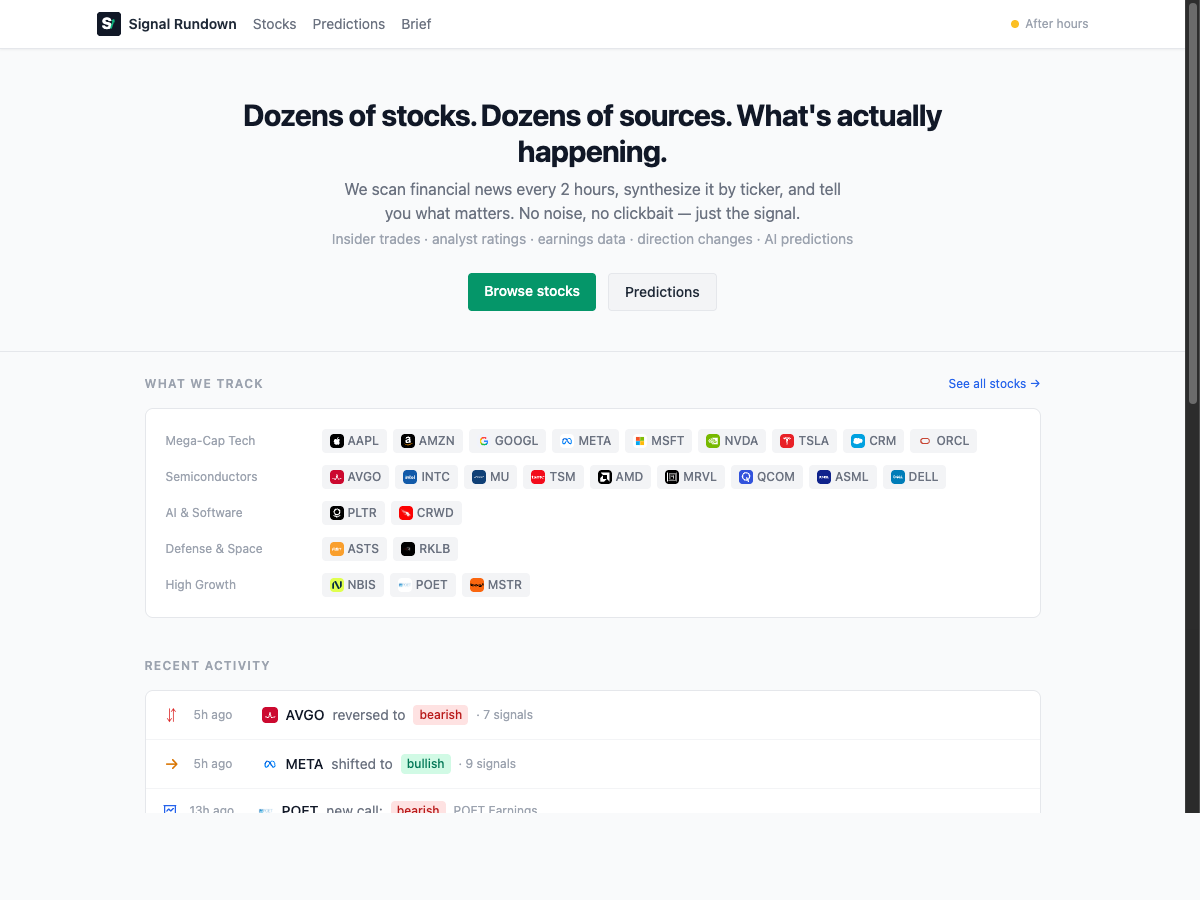
So I built The Read, then Alpha Engine, to test a specific version of the AI-trading idea: can an AI system turn public market information into structured stock views, then use those views to pick better options trades?
The short answer: the system made money on paper, but it did not prove it could beat indexing. I archived The Read and Alpha Engine on June 10, 2026.
What Ran
The actual experiment was narrower than “let AI trade.” It was an options paper book driven by public stock signals.
The Read was the intelligence layer. It read financial sources every two hours, extracted structured signals, maintained bullish/bearish/neutral views on tracked stocks, and recorded the evidence behind each view.
Alpha Engine was the measurement layer. It took those market signals, routed them into paper options strategies, recorded entries and exits, and later measured both option P&L and 30-day stock returns.
This was a live test of the Systematic game, not the Signal, Structural, or Access games. AI was not giving me proprietary data, exchange infrastructure, or inside information. It was giving me a better way to process public information.
The paper book ran from March 26 to June 9. It closed 3,885 paper-trade records. Deduped by ticker, entry date, strike, and expiry, that was 1,025 unique option setups across 165 tickers.
These were the actual experiments:
| Experiment | What it tested |
|---|---|
| Post-earnings drift | Do stocks keep moving after earnings surprises? |
| Analyst revision momentum | Do estimate revisions translate into short-term option returns? |
| Insider activity clusters | Do clusters of insider buying or selling improve the setup? |
| Convergence screens | Do multiple independent signals agreeing on the same stock matter? |
| Ranking test | Do higher-ranked ideas beat lower-ranked ideas? |
| Exit rules | Do tight exits, wide exits, or trailing stops work better on the same entries? |
The question was not “can this find a big winner?” A long-options system will occasionally do that. The question was whether the process ranked future opportunities well enough to justify active trading over a simple index baseline.
What Worked
The options book made money on paper. Across 1,025 unique closed setups, average setup P&L was +9.2%, median setup P&L was +5.6%, and the setup win rate was 57.5%. The best setup was +1,620%. The worst was a complete premium loss.
There were real winners:
| Setup | Source signal | Option result |
|---|---|---|
| VRE Jan. 2027 $20 call, entered May 25 | Analyst revision momentum | +1,620% |
| GRMN Jun. 2026 $230 call, entered Apr. 7 | Post-earnings drift | +131% |
| RIOT Dec. 2026 $16 call, entered Apr. 30 | Analyst revision momentum | +131% average, best attached account +200% |
| TEAM Dec. 2026 $85 call, entered May 25 | Analyst revision momentum | +129% |
| CMI Jun. 2026 $520 call, entered Apr. 8 | Post-earnings drift | +126% |
Post-earnings drift was the strongest broad signal: 783 closed paper-trade records, +11.7% average option P&L, 74.7% win rate. Post-earnings drift plus insider clusters looked even better, but on a smaller sample: 143 records, +24.1% average, 87.4% win rate.
That was the strongest argument for continuing.
What Failed
The systems produced the thing I wanted from them: a falsifiable record. The answer was not the one I wanted.
The book had plenty of losers too:
| Setup | Source signal | Option result |
|---|---|---|
| MSTR Jun. 2026 $174 call, entered May 13 | Analyst revision momentum | -100% |
| CRDO May 2026 $99 call, entered Mar. 28 | Analyst revision momentum | -100% |
| CRC Dec. 2026 $70 call, entered May 6 | Revision momentum + insider cluster | -82% |
| HL Dec. 2026 $20 call, entered May 13 | Revision momentum + insider cluster | -65% |
| COP Jun. 2026 $115 call, entered Apr. 13 | Post-earnings drift | -62% |
Across the deduped setups, 13 doubled or better on average, 91 gained at least 50%, 28 lost at least half, and 4 were complete premium losses across their attached strategy accounts. At the raw paper-account level, 20 records went to -100% and 47 records doubled or better.
That is what options do. A few huge winners can make the average look good while the underlying selection system is still not ranking well.
Why It Did Not Beat Indexing
The book made money, but the score did not tell me which risk was worth taking. The failure had two parts.
First, the book was structurally long and leveraged. A call-options book can look smart when the market is rising because it is taking amplified equity exposure. In an earlier matched comparison, SPY was up +2.86% over the relevant windows. A rough 4x SPY proxy was up about +11% to +12%. The best wide-exit variant was +14.2% on the same matched plays, which was basically parity after accounting for leverage. The tight and trailing exits underperformed that proxy.
Second, the score did not reliably rank future winners. On the deduped option setups, the highest score quartile averaged +6.4% while the third quartile averaged +19.6%. On the cleaner stock-return journal, which measured 30-day stock returns instead of option mark-to-market, the final score-to-return correlation was basically zero: r = +0.021, p = 0.3789, n = 1,728.
I also tested several strategy families at once: convergence, insider clusters, revision momentum, and the scoring model itself. Once those were treated as a family of tests instead of cherry-picked one by one, none cleared the evidence bar.
That is the benchmark problem from the market-games post. Making money is not the test. Active systems have to beat the passive default after leverage, costs, taxes, and time. Alpha Engine did not prove that.
So I archived The Read and Alpha Engine, exported and verified the databases, deleted the Railway Postgres services, and redirected the product domains back here.
The conclusion: the build was real, the measurement worked, and the result was a shutdown.